
Soon available on


Diversity in words, access in reality: Who really gets into the music industry’s networks?
Date:
14.1.2026
Author:
Oli Olsen
Diversity in words, access in reality: Who really gets into the music industry’s networks?
The music industry often presents itself as open and inclusive. Yet access to the most important networks is still shaped by gender, age, and background. The real question is not whether diversity is desired, but who is actually allowed in.
The music industry likes to see itself as progressive and merit based. Talent and quality are supposed to be what matters. In reality, access to the right people, the right rooms, and the right recommendations often matters far more.
Networks in music rarely form neutrally. They grow from shared history, personal relationships, and informal communities. Former classmates, long-standing collaborators, trusted circles. Once established, these networks tend to reproduce themselves.
As a result, the same people are repeatedly invited forward, while others are never given the chance.
Gender, age, and background as invisible filters
For many women in music, the challenge is not only representation but credibility. Being taken seriously as a musician, producer, or technician often requires additional proof and repeated validation. The networks exist, but the doors open more slowly.
Age is another overlooked barrier. The industry celebrates youth and early breakthroughs. Musicians who start later, return after a break, or simply carry decades of experience are often dismissed without conversation. Not because of skill, but because of assumptions about relevance.
Background matters too. If you did not attend the right schools, live in the right cities, or grow up close to cultural institutions, access to networks becomes harder. Talent alone rarely creates entry.
Diversity as narrative, not structure
When the industry talks about diversity, it often focuses on visibility. Who appears on stage. Who is featured in media. That matters, but it does not address the underlying structures.
The real issue is opportunity. Who gets recommended when a booker needs an artist. Who gets the call when a project needs a musician. Who is invited into the studio.
As long as access is governed by opaque networks and personal familiarity, diversity remains an aspiration rather than a reality.
How Beatnickel can help change access
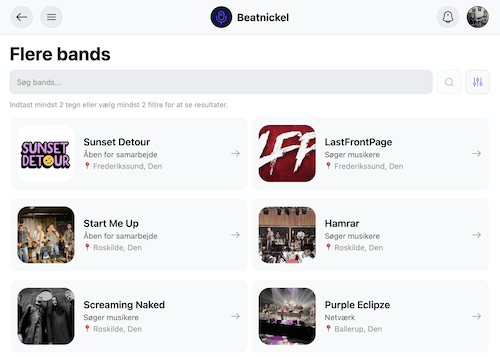
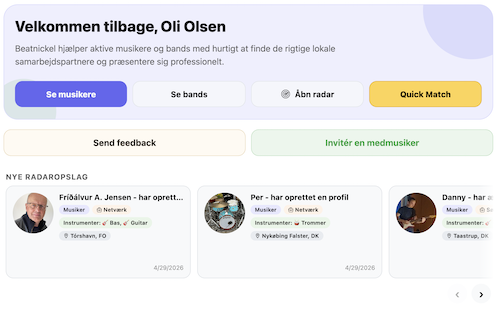
Beatnickel is built on the idea that access should not depend on who you know, but on who you are as a musician. By structuring profiles around experience, instruments, ambitions, and location, visibility becomes more equal.
When musicians and projects are matched through concrete criteria instead of intuition and existing relationships, networks open up. Not by lowering standards, but by making them visible to everyone.
Beatnickel makes it possible to be discovered without already being part of the right circles. That creates space for women, older musicians, newcomers, and those who do not fit traditional industry narratives. Not as a special diversity initiative, but as a natural result of a more transparent system.
The music industry does not lack talent. It lacks access. As long as networks remain closed, diversity will remain something we talk about rather than practice.
If the industry is serious about inclusion, it needs structures that make it easier to be seen, heard, and invited in. Platforms like Beatnickel cannot solve everything, but they can be a concrete step toward a music industry where opportunity is shaped by skill, commitment, and ambition rather than gender, age, or background.
Other blogs



































































Discover a platform built to connect musicians, simplify bookings, and fuel creative growth.
Find us on social networks


