
Soon available on


Experience Has Become an Invisible Currency in the Music World
Date:
5.2.2026
Author:
Oli Olsen
Experience Has Become an Invisible Currency in the Music World
In a music world driven by speed, visibility, and constant relevance, experience is losing its value. Not because it matters less, but because it is increasingly hard to see. As a result, many experienced musicians are being pushed out of sight, even though they form the backbone of everyday music life.
The music world has always thrived on renewal. New expressions, new voices, and new movements are essential to its vitality. But something has shifted. Where experience once carried clear weight, it has now become largely invisible. Not rejected outright, but overshadowed by pace, algorithms, and constant motion.
Today, what is rewarded is what is new, fast, and visible. This applies to social platforms, booking decisions, and collaborations alike. For many musicians with decades of experience, this means their skills and reliability count less than their most recent activity. What matters is not what you can do, but how recently you did it.
When experience cannot be seen, it gets ignored
Experienced musicians carry much of the practical music ecosystem. They keep bands running, rehearsals working, and collaborations functional. They show up on time, understand logistics, and know what it takes behind the scenes to make projects work.
Yet this kind of experience is difficult to capture in the digital spaces where much of today’s music life is organized. Profiles often highlight recent activity and constant output, not long term reliability, consistency, or accumulated knowledge.
When experience has no clear place, it is easily overlooked. Not out of malice, but because the systems are not designed to surface it.
Speed beats continuity
Many collaborations form quickly and dissolve just as fast. Projects are launched without clear expectations, and relationships fade before they have time to mature. In that logic, experience can feel like friction. It takes time. It is built through repetition, responsibility, and long term commitment.
But continuity is exactly what keeps the music world functioning in practice. Experience is what makes the difference when something goes wrong. When structure is missing. When responsibility matters more than momentum.
An ecosystem out of balance
When experienced musicians are pushed out of view, the music world loses its backbone. Not only culturally, but structurally. Knowledge disappears. Standards erode. Collaborations become fragile.
This affects more than the experienced musicians themselves. Younger and less experienced musicians lose access to mentors, role models, and stable collaborators. A healthy music ecosystem needs both energy and experience. Not one instead of the other.
Where Beatnickel makes a difference
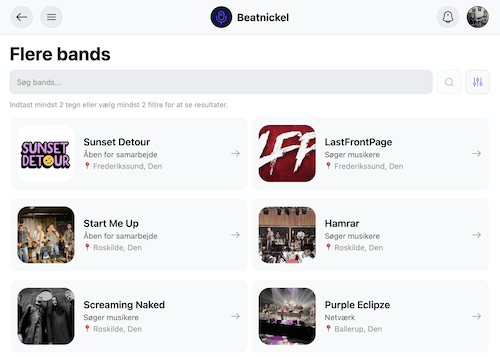
Beatnickel is built on a different logic. Here, experience does not disappear into the background. It is given space. Profiles and matches are not based solely on what is newest or fastest, but also on continuity, reliability, and collaboration history.
By making experience visible, Beatnickel supports a more balanced music ecosystem. A place where young, emerging, and experienced musicians can find each other on informed terms. Where collaboration is chosen for more than just speed and exposure.
Experience has not become less valuable. It has become harder to see. In a fast moving music world, it is essential to create room for what lasts. Beatnickel works to make experience a visible and respected currency again. Not as nostalgia, but as a foundation for a sustainable music life.
Other blogs







































































Discover a platform built to connect musicians, simplify bookings, and fuel creative growth.
Find us on social networks


