
Soon available on


Musicians do not lack talent. They lack context.
Date:
28.4.2026
Author:
Oli Olsen
Musicians do not lack talent. They lack context.
There are plenty of talented musicians out there. The problem is not always finding talent. The problem is understanding where that talent fits right now.
When you see a musician online, you often only see a photo, a short bio and maybe a link. But you miss the context: What are they looking for? What role do they want to play? Are they ready for a serious band, a casual session or just new connections?
Talent does not tell the whole story
The music world is full of people who can do something. Guitarists, singers, drummers, producers, bass players, songwriters and sound engineers. Many have experience, ideas and a desire to play more.
But talent alone is not enough.
A guitarist may be technically strong, but only looking for a casual hobby band. A singer may have a great voice, but mainly be interested in studio projects. A drummer may have years of experience, but only want to join bands with gigs already in the calendar. A producer may be creative and ambitious, but only have time for a few selected collaborations.
When you only see a name, a photo and a short text, it becomes difficult to know whether that person actually fits what you are looking for.
Online profiles often show too little
Many musicians present themselves online in the same way as everyone else. A profile picture, a short bio, a few links and maybe some videos.
That can look good. It can even be impressive.
But it rarely answers the practical questions that matter in a musical collaboration.
Is this person looking for a band?
Do they want to start something new?
Are they open to session work?
Are they interested in gigs?
Do they want to network?
Is their ambition casual, semi professional or professional?
How far are they willing to travel?
Which genres make sense?
What role do they actually want to play?
This is where many opportunities are lost. Not because people are not talented enough, but because they are not understood in the right context.
Context makes musicians more relevant
In music, relevance is not only about skill. It is also about timing, intention, role and local fit.
Two musicians may look perfect for each other on paper, but if one is looking for a fixed band and the other only wants loose sessions, the match may not be right.
A band may need a bass player, but if the bass player is looking for something completely different, there is no real match.
A singer may be exactly what a new project needs, but if nobody knows that she is actually open to starting something new, the opportunity never becomes visible.
That is why context matters. It helps musicians, bands and projects understand each other faster.
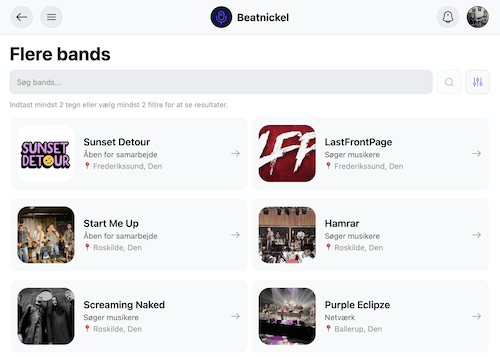
Beatnickel is about more than a profile
On Beatnickel, a musician profile is not just a presentation. It is also a signal of what you are looking for right now.
That makes a big difference.
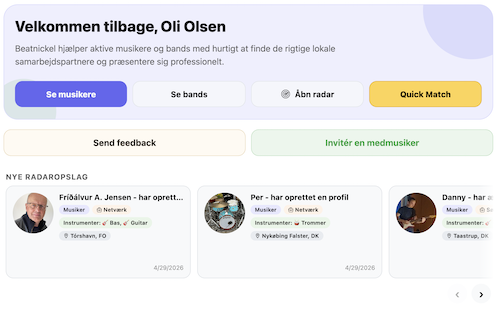
When a musician adds instruments, genres, role, location and status, the profile becomes more useful. It does not only show who the person is. It shows where that person fits.
That means bands can find relevant musicians more easily. Musicians can find bands more easily. And new collaborations can happen based on more than random posts and fast comments.
Beatnickel makes talent easier to understand.
From static profile to active intention
A normal online profile is often static. It says something about what you have done or how you want to present yourself.
But the music world is dynamic.
You can be focused on one project for a while and look for something new later. You can be ready for gigs now, but later become more interested in studio work. You can be open to collaboration without necessarily wanting to join a permanent band.
That is why it is important for a profile to show intention.
What are you looking for right now?
What are you open to?
What type of musical relationship makes sense?
That kind of information makes a profile alive and useful.
The right match requires more than visibility
Visibility matters. But visibility alone does not necessarily create good collaborations.
If a musician is seen by many people, but nobody understands what they are actually looking for, the visibility is weak. If a band receives many messages from people who do not fit the role, the process becomes heavy. If opportunities are only shared through unstructured posts, it is often the fastest person, not the most relevant person, who gets the chance.
Beatnickel changes the logic.
Instead of only asking “who are you?”, the platform also asks “what are you looking for?”
That makes musicians easier to find, easier to understand and easier to match with the right people.
Musicians rarely lack talent. What they often lack is a better way to be understood.
A photo, a bio and a link can show something about a person. But they do not necessarily show what the person is looking for, what role they want to play or what type of collaboration makes sense right now.
Beatnickel makes musician profiles more contextual. Here, a profile is not only about identity. It is also about intention.
That is the difference between simply being visible and actually being relevant.
Other blogs






















































Discover a platform built to connect musicians, simplify bookings, and fuel creative growth.
Find us on social networks


