
Soon available on


The music scene lacks transparency about level and seriousness
Date:
14.3.2026
Author:
Oli Olsen
The music scene lacks transparency about level and seriousness
Many musical collaborations begin with excitement and good intentions, but end in frustration because the people involved are not working from the same expectations. Is it a hobby project, a student project, or a professional pursuit? When that is unclear from the start, misunderstandings follow. That is why transparency is one of the most important things the music scene is missing.
It is often easy to find someone who plays, sings, produces, or writes music. What is much harder is understanding what they actually want from it. Many musicians have said yes to a collaboration that sounded promising, only to discover that it was something very different from what they expected.
Maybe you thought you were joining a serious band project with clear goals and plans for releases and live shows. In reality, it turned out to be something the others saw as a casual pastime with no real ambitions. Or the opposite. You thought it would be a relaxed side project, only to discover that the others expected full commitment, frequent rehearsals, and professional priority.
It is not because one approach is more right than the other. The problem begins when nobody really knows what the other person means by words like serious, ambitious, or professional.
Misunderstandings cost time and energy
When level and seriousness are unclear, motivation and relationships often suffer. Musicians spend time messaging, meeting, rehearsing, and planning before they realize they are not aligned at all.
That can lead to irritation and disappointment. One person may feel that the others are not taking the project seriously enough. Another may feel pressured by expectations they never agreed to. Instead of using their energy on the music, they end up using it on cleaning up misunderstandings.
For many people, this becomes a repeated experience. They become more cautious. More skeptical. And sometimes they say no to opportunities simply because earlier collaborations were too unclear from the beginning.
The music scene includes many different ambitions
One of the great strengths of the music scene is that it includes many kinds of people and many kinds of projects. Some play purely for the joy of it. Some are studying and looking for experience. Some are building a professional career with intention. Others are somewhere in between.
All of these levels are valid. There is nothing wrong with being hobby based, and there is nothing wrong with being professionally oriented. The challenge only appears when those differences are invisible.
The more diverse the music scene becomes, the more important it is to signal clearly what your project is and what you are looking for in others. Not to exclude people, but to make it easier to find the right match.
It should be clear what you are saying yes to
If musicians and bands could show their level of ambition, activity, and status from the beginning, a lot would become easier. It would be much simpler to see whether a project is a casual collaboration, a development opportunity, or a professional pursuit.
It makes a real difference to know whether a band rehearses every week or every second month. Whether they are working toward gigs and releases, or simply meeting when time allows. Whether they are looking for someone who wants to be fully committed, or someone who is happy to join more casually.
This kind of information may seem simple, but it is essential. It creates clarity because expectations are aligned earlier. It saves time because people can quickly judge whether a collaboration is relevant. And it leads to better relationships because both sides understand what they are stepping into.
Beatnickel can create the transparency the music scene needs
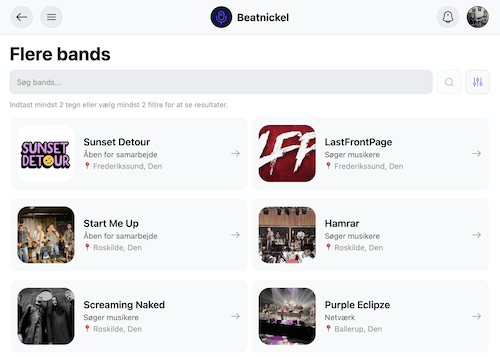
This is where Beatnickel can play an important role. If profiles and listings make it clear what level of ambition a musician or a band has, it becomes much easier to find collaborations that are actually a good fit.
Clear statuses can show whether someone is an active hobby musician, a student, semiprofessional, or professional. Ambition levels can make it obvious whether the goal is enjoyment, development, gigs, releases, or career growth. Activity markers can show how often people rehearse, how active the profile is, and whether there is real momentum in the project.
That creates a more honest and useful picture of reality. Not a polished image, but a real alignment of expectations. And that is exactly what is missing in many places today.
Better matches create a stronger music environment
When people can more easily find collaborations that match their level and goals, the music scene becomes healthier. Fewer people walk away disappointed. More people feel that their time and commitment are respected. And more people find the right collaborators faster.
That benefits not only the individual musician or band. It benefits the whole ecosystem. Good collaborations rarely happen by chance. They happen when there is clarity, shared direction, and mutual understanding from the start.
The music scene does not lack talent or willingness. What it often lacks is transparency. When it is unclear whether a project is a hobby, a student project, or a professional pursuit, misunderstandings and frustration quickly follow. That is why clarity about level, ambition, and activity is not a small detail. It is essential. With clear statuses, ambition levels, and activity markers, Beatnickel can make it easier to understand what you are saying yes to and help create better matches, stronger collaborations, and a healthier music scene.
Other blogs








































































Discover a platform built to connect musicians, simplify bookings, and fuel creative growth.
Find us on social networks


