
Soon available on


Talent is everywhere, but too much of it stays trapped in local pockets
Date:
12.3.2026
Author:
Oli Olsen
Talent is everywhere, but too much of it stays trapped in local pockets
The music world is full of strong musicians in small towns, local scenes, and niche communities. The problem is not a lack of talent. The problem is that talent often remains invisible outside the circle where it is already known. This is where Beatnickel can help build bridges between environments, cities, and genres so more people can find each other across boundaries.
Talent exists everywhere. In big cities, in small towns, in rehearsal rooms far from the main stages, and in scenes that only insiders know. There are skilled drummers in rural areas, strong songwriters in the suburbs, experienced bass players in small local networks, and original bands in niche communities that rarely get discovered outside their own circles.
It is not because they lack ability. It is not necessarily because they lack ambition either. Very often, they simply lack connections. The music world is still shaped by geography, habits, and existing networks. Many collaborations begin through friends, acquaintances, former bandmates, or posts in the same closed circles. That means a great deal of talent never gets connected with the people who are actually looking for exactly what those musicians can offer.
The result is that the music world loses opportunities. Bands are missing members even though the right musicians exist somewhere else. Musicians are searching for projects even though relevant bands may already be active just a few cities away. Genres and communities grow inside their own pockets, but they rarely meet in ways that create new collaborations and new sounds.
When networks matter more than ability
In practice, this often means that visibility depends more on who you know than on what you can do. If you live in an area with a strong music scene, your chances of being seen, heard, and invited in are much greater. If you live somewhere with fewer connections or play in a niche genre, you may be just as talented but much harder to discover.
This imbalance affects young musicians, amateurs, and professionals alike. A young musician may have a lot of talent but no access to the right communities. An experienced musician may have high quality and great reliability but little digital visibility. A niche band may have a clear artistic identity but struggle to reach people outside the narrow circle where everyone already knows each other.
It is not healthy for the music world when so much depends on coincidence and local connections. The more talent gets trapped in small pockets, the less movement, renewal, and collaboration the music world will have across scenes and cities.
Local scenes are a strength, but they must not become closed rooms
Local environments matter. They are often where musicians grow, build confidence, test ideas, and form relationships. Local scenes create identity, closeness, and belonging. They should not be replaced. They should be strengthened.
But they must not become closed rooms where opportunity stops at the city border or at the unwritten rules of a genre. When talent only circulates inside the same circles, the music world becomes less open. Not because anyone wants it that way, but because the infrastructure is missing.
What is missing are places where a musician from a small town can be discovered by a band in a bigger city. What is missing are places where a niche project can find collaborators without first knowing someone personally. What is missing is a way to make local strengths visible across geographical and musical boundaries.
Beatnickel can make talent visible across scenes
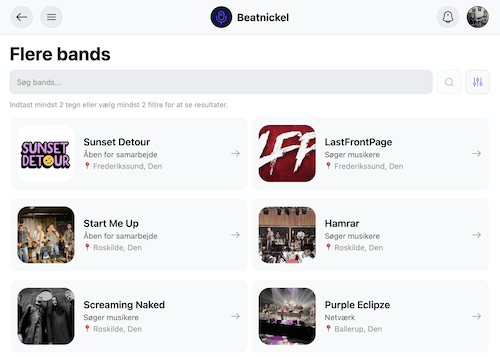
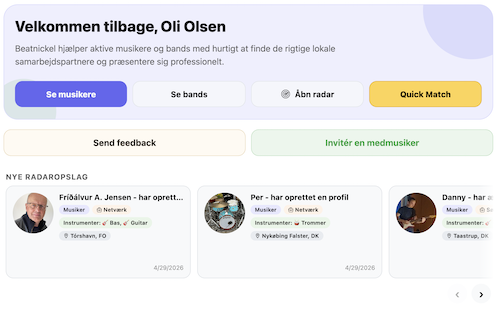
This is where Beatnickel has real strength. The platform can help build bridges between local music communities instead of replacing them. When musicians and bands have clear, rich profiles, it becomes easier to show who they are, what they can do, what they are looking for, and where they come from. That makes talent more visible, even outside the circles that already know it.
When connections are not created only through random posts or personal networks, but through relevant matching and visible profiles, it becomes much easier to discover each other across cities and genres. A guitarist in Holstebro can become relevant to a band in Roskilde. A singer in Svendborg can find a collaboration with producers in Aarhus. A niche band can discover musicians who are a perfect fit, even if they have never moved in the same circles before.
Beatnickel can help shift the focus from who you already know to what you actually bring to the table. That makes the music world more open, more dynamic, and more fair.
When more connections happen, the whole music world grows
When talent becomes visible across boundaries, it does not only benefit individual musicians or bands. It benefits the entire ecosystem. More relevant connections mean more collaborations, more projects, more concerts, and stronger local scenes that are still open to the outside world.
It also means the music world becomes less dependent on a few central hubs and more shaped by movement between different places and communities. That creates space for greater diversity because more kinds of musicians get the chance to be seen and chosen. Not only those who happen to be in the right room at the right time.
Talent is not concentrated in just a few places. It exists everywhere. In small towns, in niche genres, and in communities that rarely get the attention they deserve. The challenge is that too much talent stays trapped in local pockets because the connections to the wider music world are missing. Beatnickel can help change that by making musicians and bands visible across cities and genres. When more people can find each other based on relevance instead of coincidence, we get a stronger, more open, and more vibrant music world.
Other blogs













































Discover a platform built to connect musicians, simplify bookings, and fuel creative growth.
Find us on social networks


