
Soon available on


A band is not just a sound, it is an organisation
Date:
19.5.2026
Author:
Oli Olsen
A band is not just a sound, it is an organisation
Many bands start with energy, ideas and the desire to play music together. But if roles, communication, ambitions and decisions are unclear, even good bands can quickly lose momentum.
A strong band is not only about sounding good. It is also about structure, responsibility and relationships.
When people look at a band from the outside, they usually notice the music first. The songs, the sound, the energy on stage and the chemistry between the members. But behind every band there is something just as important: the organisation.
Even the smallest band has to function like a small team. Rehearsal times have to be planned. Decisions have to be made. Someone has to think about gigs, recordings, money, social media, equipment, transport and ambitions. There also has to be room for different personalities, different skill levels and different expectations.
This is where many bands struggle. Not necessarily because the music is bad, but because the structure around the music is unclear.
A band needs more than talent
Talent can start a band, but it rarely keeps it together on its own.
A band is made up of people, and people have different needs. Some want to rehearse twice a week. Others just want to play for fun. Some dream of festivals and record deals. Others are happy playing locally. Some are good at taking responsibility. Others expect things to happen by themselves.
If those differences are not discussed, they can quickly create frustration.
It often starts small. A rehearsal that gets cancelled. A message that is not answered. A member who is always late. A decision that nobody really made. Over time, these things stop being small practical problems. They become trust problems.
Unclear structure can break good bands
Many bands do not fall apart because of bad music. They fall apart because nobody knows who is responsible for what.
Who books the rehearsal room?
Who contacts venues?
Who manages social media?
Who keeps track of the setlist?
Who makes the decision when the band disagrees?
If all responsibility sits with one person, that person often burns out. If nobody takes responsibility, nothing happens. Both situations can hurt a band.
That is why bands need more awareness of roles. Not in a heavy or overly formal way, but in a way where everyone understands what they contribute.
Communication is the band’s invisible instrument
A band can have a great drummer, a strong singer and a talented guitarist, but if the communication does not work, it becomes difficult to build something stable.
Good communication is not just about writing in a group chat. It is about being clear about expectations, plans and decisions.
When do we rehearse?
What are we working towards?
Do we agree on the level of ambition?
Who are we missing in the band?
What do we need to improve?
When these questions are not answered, members begin to guess. And when people guess, misunderstandings grow.
Bands need both internal and external structure
A band has to work internally and be able to present itself externally.
Internally, it is about members, roles, rehearsal times, goals and communication. Externally, it is about profile, visibility, music, links, images, genre, location and what the band is looking for.
For many bands, all of this is scattered across old messages, Facebook posts, Google Docs, private notes and verbal agreements. That makes the band fragile. When things are unclear, it becomes harder to take the next step.
This is where Beatnickel can play an important role over time.
From match platform to a digital base for bands
Beatnickel starts as a place where musicians and bands can find each other. But the need does not stop when the match is made.
When a band has found a new bassist, drummer or singer, the next challenge begins: how does the band become stronger together?
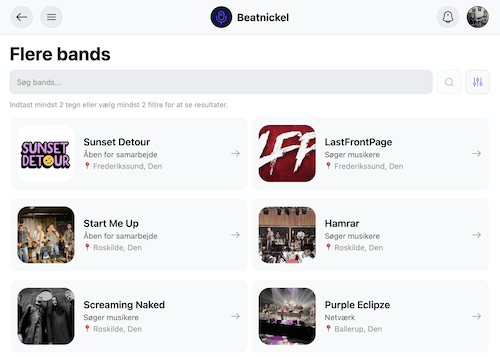
Beatnickel can grow from a match platform into a place where bands are not only found, but also presented, organised and connected. This can happen through band profiles, roles, open needs, links, images, music, ambitions and clear information about what the band is and where it wants to go.
In that way, Beatnickel can become more than a place to look for musicians. It can become a place where bands build their identity.
A stronger band is easier to find and easier to understand
When a band has a clear profile, it becomes easier for others to understand who they are.
It helps musicians who are considering contacting the band. It helps venues, organisers and potential collaborators. It also helps the band itself, because the members are forced to put their direction into words.
What do we play?
Who are we?
What are we looking for?
How serious are we?
What can we offer?
That kind of clarity can be the difference between a band that keeps starting over and a band that slowly builds something stronger.
A band is not just a sound. It is a small organisation with people, roles, ambitions, communication and decisions.
The music is of course at the centre, but the structure around the music often determines whether the band survives and develops. When roles are unclear, responsibility is floating and expectations are not discussed, even good bands can fall apart.
Beatnickel can help make band life more visible, more structured and more professional. First by matching musicians and bands. Later by giving bands a place where they can present themselves, organise themselves and build stronger relationships both internally and externally.
Because a strong band is not only about sounding good together. It is also about functioning well together.
Other blogs





































































Discover a platform built to connect musicians, simplify bookings, and fuel creative growth.
Find us on social networks


