
Soon available on


The hardest part of starting a band is not the music
Date:
12.5.2026
Author:
Oli Olsen
The hardest part of starting a band is not the music
Many people think the hardest part of starting a band is writing songs, rehearsing enough, or finding the right sound. But often, the real challenge is finding people with the same timing, ambition, style, and expectations.
Starting a band sounds simple.
You find some musicians, agree on a rehearsal day, play a few songs, and see what happens. But anyone who has tried it knows that reality is rarely that easy.
The music matters, of course. You need to be able to play together. You need some shared taste. You need a common feeling for sound, energy, and direction.
But that is rarely where the biggest problem begins.
The hardest part is often the people around the music.
Who has time? Who wants the same thing? Who practices at home? Who dreams of playing live? Who just wants to play for fun? Who can rehearse every Tuesday? Who lives close enough for the project to actually work in everyday life?
A band is not only a musical project. It is also a collaboration, a calendar, an expectation match, and a shared rhythm between people.
When ambitions do not match
Many bands do not fall apart because the musicians are bad. They stop moving forward because the ambitions do not match.
One person wants to write original songs and play live as soon as possible. Another would rather play covers once a month. One person wants serious rehearsals and expects everyone to come prepared. Another sees rehearsal as a relaxed space with no pressure.
Both approaches can be completely valid. The problem starts when people think they want the same thing, but later discover that they do not.
That is why forming a band is not only about finding a guitarist, bassist, drummer, or singer. It is about finding people who fit the way you want to be a musician.
Genre is only the beginning
Many musicians search for bandmates based on genre. Rock, metal, pop, jazz, funk, indie, or folk.
That makes sense, but genre is only part of the picture.
Two musicians can both love rock and still be a poor match. One wants to play original music and aim for festivals. The other wants to play classic rock songs at local events. One wants to build a serious project. The other simply wants a good night in the rehearsal room.
That does not mean one is more right than the other. It simply means they are looking for different things.
That is why it is important to look beyond musical taste. Role, location, level, intention, and expectations matter too.
Timing matters more than people think
A band can only work if the timing works.
That is about both life situation and practical availability. A musician can be talented, committed, and musically perfect, but if they do not have time, live too far away, or cannot rehearse at the same times, the project becomes difficult to get off the ground.
Many musical opportunities do not disappear because the idea is bad. They disappear because the contact is random, the post is forgotten, or people never find out whether they are actually looking for the same thing.
This is where band formation often becomes frustrating. You are not only looking for talent. You are looking for a practical and human match.
Beatnickel makes band formation more concrete
Beatnickel is built to make it easier to find the right musical relationships.
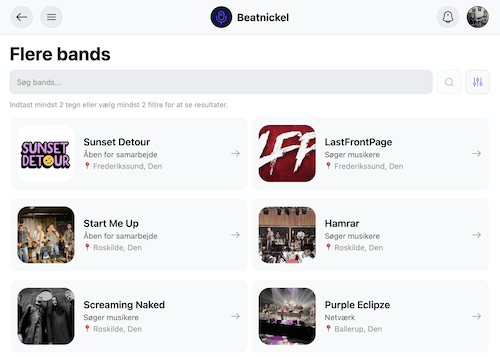
Instead of only searching for someone who plays a certain instrument or likes a certain genre, musicians and bands can be found through several relevant criteria.
It is about the role you have. Where you are based. What you are looking for. Whether you want to join a band, start a new project, collaborate with other musicians, or expand your network.
For bands, it is about becoming visible to the musicians they actually need. For musicians, it is about being found by bands and projects where their role, style, and intention make sense.
That makes the process more concrete and less random.
From posts to relevant matches
Many musicians are used to searching in Facebook groups, old networks, or random posts. That can work, but it is often messy and short lived.
A post can quickly disappear. A good candidate may never see it. An interested musician may reach out even though there is no real match. And often, the most important information is missing from the start.
Where does the band rehearse? How serious is the project? What role is missing? What is the goal? Are there gigs coming up? Is it original music or covers? Is the ambition fun, development, or professional activity?
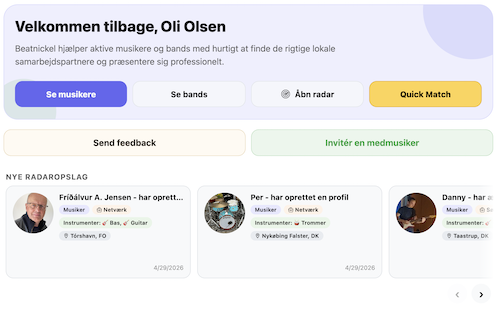
Beatnickel brings this information into profiles and matches, making it easier to see whether there is something worth building on.
A good band starts with clarity
The best music does not only happen when people can play. It happens when people understand each other.
A good band needs chemistry, but chemistry becomes easier when expectations are clear from the beginning.
When you know what people are looking for, what they can do, where they are, and what they want, it becomes easier to make the first contact. It also becomes easier to avoid the matches that would never have worked anyway.
That saves time. It reduces frustration. And it gives more musicians the chance to find the right collaborations.
The hardest part of starting a band is often not writing songs, finding rehearsal time, or playing well enough. The hardest part is finding people who fit together musically, practically, and in terms of ambition.
Genre matters, but it is not enough. Role, location, timing, intention, and expectations matter just as much.
Beatnickel makes band formation more concrete by helping musicians and bands find each other based on the things that actually make a collaboration work.
Because a band does not only start with the music.
It starts with the right people.
Other blogs






















































Discover a platform built to connect musicians, simplify bookings, and fuel creative growth.
Find us on social networks


