
Soon available on


Musical chemistry starts before the first rehearsal
Date:
3.6.2026
Author:
Oli Olsen
Musical chemistry starts before the first rehearsal
When musicians meet for the first time, a lot has already been decided. Not only by talent, but by expectations, energy, level, ambition and the way people work.
That is why the right match is not just about finding a guitarist, drummer, singer or bass player. It is about finding people who want the same kind of musical collaboration.
There is something special about the first rehearsal.
You show up with your instrument, your experience, your hopes and maybe a little nervousness. You listen carefully. Does it work musically? Is there energy in the room? Is there respect? Are people on roughly the same level? Do they want the same thing from the music?
But the truth is that much of the chemistry is often decided before anyone plugs in an amp or counts in the first song.
Musical chemistry does not appear out of nowhere. It is built on expectations, ambition, work habits, taste, experience and personality. If those things are too far apart, even very talented musicians can end up wasting each other’s time.
Talent is not enough
Many musicians start by looking for skilled people.
That makes sense. A band needs musicians who can play. A singer needs to sing. A drummer needs to hold a groove. A bass player needs to create the foundation. A guitarist needs to listen and not just fill every space.
But talent alone does not create a good collaboration.
A highly skilled musician can still be the wrong match if they want to rehearse five times a week while the rest of the band only wants to meet every other Sunday. An experienced musician can be the wrong fit if their ambition is professional, while the band mainly plays for fun. A technically strong musician can be difficult to work with if they do not listen to others.
So the real question is not only: Can this person play?
It is also: Does this person want the same thing as we do?
Expectations are often the invisible problem
Many musical collaborations do not fall apart because of bad chords.
They fall apart because people have different expectations.
One person thinks the band should start playing gigs quickly. Another wants to spend a year in the rehearsal room. One wants to write original songs. Another wants to play covers. One expects everyone to practise at home. Another sees rehearsal as the place where things are figured out together.
None of these approaches are necessarily wrong.
The problem starts when they are not said out loud.
Then frustration slowly builds. Someone feels that others are not taking it seriously enough. Someone else feels the project has become too strict. One person shows up unprepared. Another gets irritated. And in the end, what could have been a good musical meeting becomes yet another project that never really gets started.
Level is also about how you work
When musicians talk about level, many think about technique.
But level is also about how you work.
Do you show up prepared? Can you receive feedback? Can you play with others without dominating? Can you learn new songs quickly? Can you keep agreements? Can you contribute creatively without taking over?
These are often the things that decide whether a collaboration works in real life.
A band with decent musicians who listen, show up, work seriously and pull in the same direction can often get much further than a band full of technically strong musicians who all want different things.
Ambition needs to match
Ambition is one of the most important parts of a musical match.
Some musicians want to play gigs every month. Some want to record and release music. Some want to tour. Some want to play locally. Some simply want a good community and a regular rehearsal night. Some just want to see where things go.
All of these ambitions are valid.
But they need to fit together.
If one person dreams of going professional while the rest of the band mainly wants to play for fun, imbalance quickly appears. If a band is looking for someone who can prioritise the project highly, it will not help much to find a person who only wants a casual side project next to three other commitments.
That is why ambition should be clear early on.
Not to reject people harshly, but to give everyone a fair chance to choose the right collaboration.
Musical chemistry cannot be guaranteed, but it can be prepared
You can never know for sure whether the chemistry is there until you meet and play together.
The spontaneous part still matters. The energy in the room matters. The way people respond to each other matters. Sometimes something unexpected happens that no profile text could ever predict.
But many obvious misunderstandings can be removed in advance.
What genre do you want to play? How serious should it be? How often do you want to rehearse? Are you looking for permanent members, loose collaborations or new contacts? Is the goal gigs, recording, creative development or community? What role do you want to have in the project?
When these things are clear, the first rehearsal becomes better.
Not because everything is decided beforehand, but because people meet with a more honest starting point.
Beatnickel makes it easier to clarify things before the first meeting
Beatnickel is built to make musical matches more concrete.
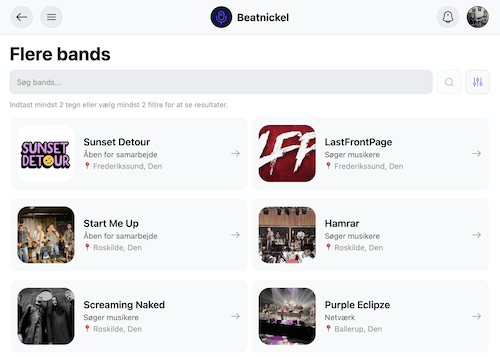
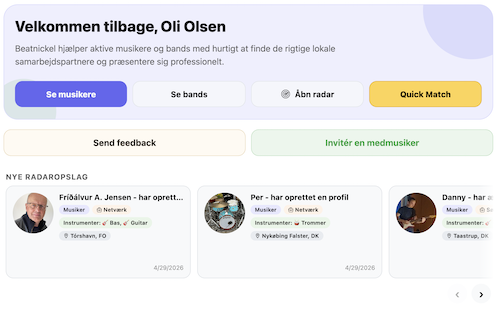
Instead of only seeing a name, a photo and maybe a post in a Facebook group, musicians and bands can show more of what actually matters.
Which instrument do you play? What genres do you work with? Where are you based? What are you looking for right now? Are you looking for a band, a project, a collaborator or a new musician? What level and direction fit you best?
This makes it easier to judge whether a meeting makes sense before spending time writing back and forth, planning a rehearsal and showing up without knowing whether there is any real foundation.
Beatnickel does not remove the need to meet.
On the contrary.
The platform is there to help more musicians meet the right people.
Less wasted time, better collaborations
For many musicians, time is one of the biggest limitations.
There is work, family, studies, other bands, transport, rehearsal times and everyday life. That is why it is frustrating to spend time on collaborations that quickly turn out to have no real chance.
That does not mean musicians should become cynical.
It means they should be clear.
The better musicians can describe what they are looking for, and the better bands can explain what they need, the greater the chance that the right people will find each other.
That leads to fewer random meetings and more relevant meetings.
Musical chemistry starts before the first rehearsal.
It starts with expectations, ambition, level, energy and the way people want to work. Talent is important, but it is not enough. A good match also requires people to want something similar and understand each other’s starting point.
Beatnickel can help make the most important things clear before musicians meet for the first time. That gives better conditions for good collaborations and less time wasted on projects that never had a real chance.
Because when the starting point is clear, it becomes easier to find the musical chemistry that can actually turn into something.
Other blogs














































































Discover a platform built to connect musicians, simplify bookings, and fuel creative growth.
Find us on social networks


