
Soon available on


Musicians Should Be Able to Find Each Other Without Knowing the Right People
Date:
16.6.2026
Author:
Oi Olsen
Musicians Should Be Able to Find Each Other Without Knowing the Right People
Many music scenes still rely heavily on personal networks. That can be a strength, but it can also make it harder for new, young or less visible musicians to find their way in. Beatnickel makes access more open by helping musicians find each other based on relevant data instead of only existing connections.
Many musical collaborations still begin through personal networks. Someone knows a drummer, who knows a bassist, who once played with a guitarist, who might know a singer.
That is how music scenes have worked for years. And there is something valuable in that. Trust, experience and personal recommendations matter when you are looking for people to play with.
But there is also a downside.
What do you do if you are not already part of the scene? What if you are young, new in town, new to the industry or simply do not yet know the right people?
Then access to musical opportunities can quickly become too random.
Networks benefit those who are already inside
In many local music scenes, there are invisible doors. Not necessarily because anyone wants to keep others out, but because information often moves through small circles.
A band may need a keyboard player, but the question is only asked within a closed group of friends. A guitarist may be looking for a new project, but no relevant bands know it. A young singer may have talent, but not yet have access to the people who could open the first door.
That means opportunities do not always go to the people who are the best fit. They often go to the people who are already visible inside the network.
That may not be unfair on purpose. But it is still a problem.
New and less visible musicians are easily overlooked
For new musicians, finding a way into a music scene can be difficult. You can be talented, serious and motivated, but still lack the right contacts.
The same is true for musicians who have taken a break, moved to a new city or play in a niche genre. They may have a lot to offer, but if nobody knows they exist, nothing happens.
Many musicians end up waiting. Waiting for a post. Waiting for a friend who knows someone. Waiting for the right accidental meeting to happen.
But musical opportunities should not depend only on chance.
Relevant data can open up the music scene
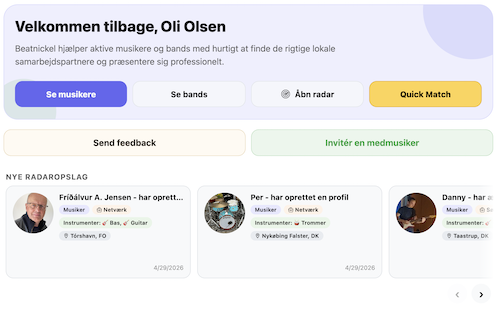
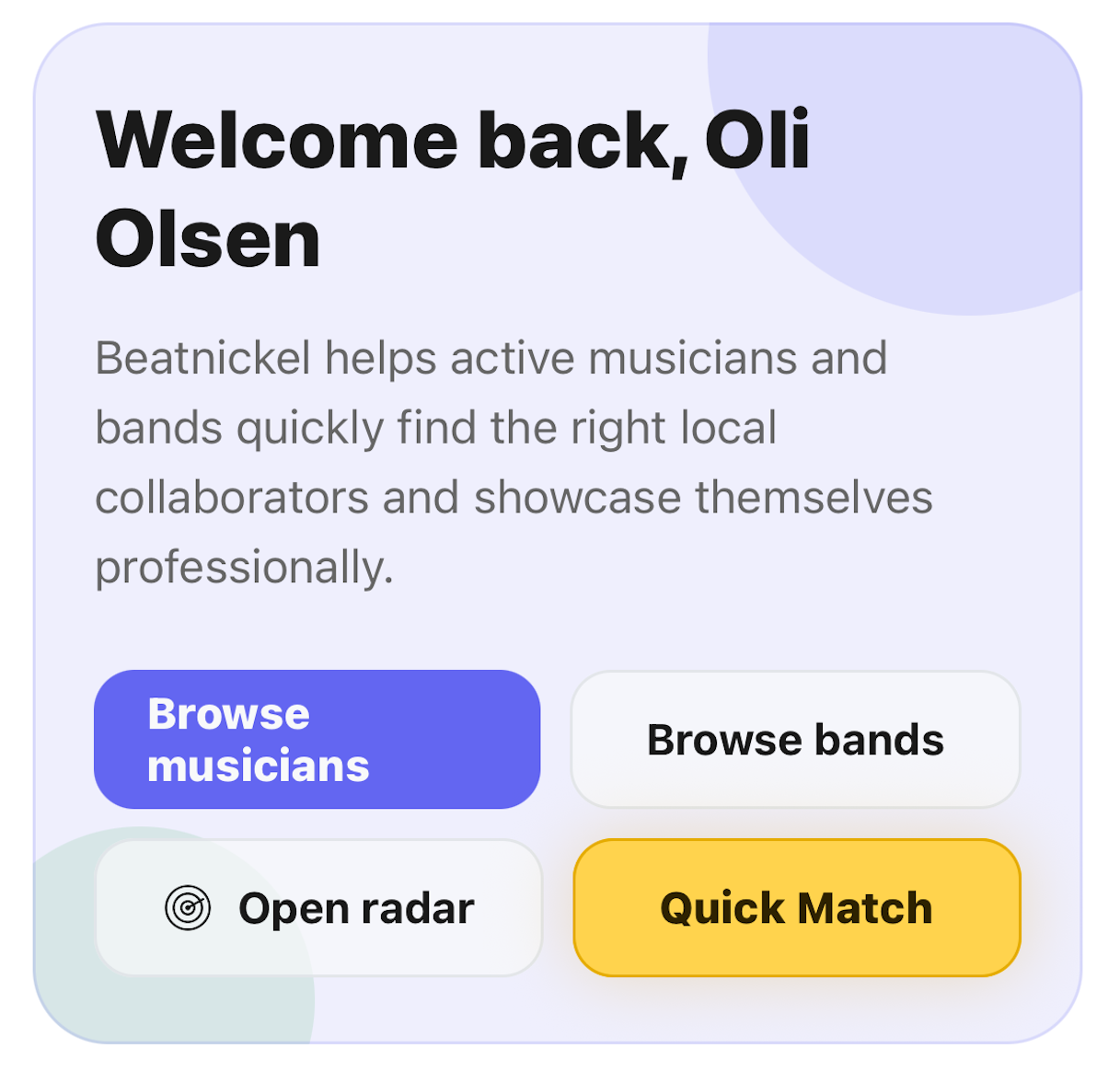
Beatnickel is built on a simple idea: musicians should be able to find each other based on what actually matters.
What instrument do you play? What genres do you work with? Where are you located? Are you looking for a band? Do you want to start something new? Are you open to collaboration? What level and ambition do you have?
When that kind of information is structured, it becomes much easier to find relevant people. Not because you already know the right person, but because you are a good musical match.
That makes the search more open. A guitarist can find bands that are actually looking for guitar. A band can find a bassist in the right area. A singer can become visible to musicians who are looking for exactly that kind of voice.
It is not about replacing networks. It is about making access wider.
From closed circles to open opportunities
A strong music scene will always need relationships, trust and personal recommendations. But those relationships need a chance to begin.
That is why it matters that musicians can discover each other without first being part of the right circles. This is especially important for young musicians, new musicians and those who are not the loudest voices in the room.
Beatnickel can be a first point of entry. A place where you can be found because your profile shows who you are, what you play and what you are looking for.
That gives more musicians a real chance to get started.
When more musicians become visible, the whole music scene grows stronger
A more open music scene does not only help the individual musician. It also helps bands, venues, rehearsal spaces and the entire local music community.
When more musicians become visible, it becomes easier to form bands. Easier to find replacements. Easier to start new projects. And easier for talent to find people they can grow with.
That creates more activity. More meetings. More collaborations. More bands.
And in the end, more music.
Musicians should not have to depend on knowing the right people in order to find relevant collaborations.
Networks will always play a role in music. But access to opportunities should be more open. Beatnickel makes it possible for musicians and bands to find each other based on instrument, genre, location, status and ambition instead of only existing contacts.
When musicians can be found for what they actually play, offer and seek, more people get access to the music scene.
That is good for the individual musician. And it is good for the entire music community.
Other blogs








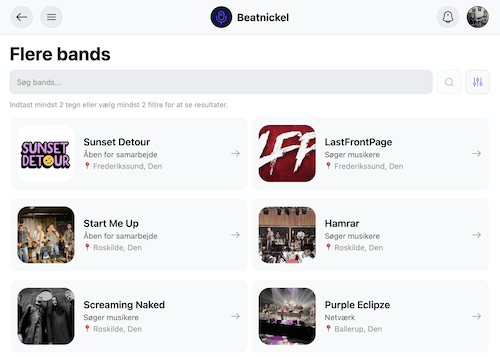





































Discover a platform built to connect musicians, simplify bookings, and fuel creative growth.
Find us on social networks


