
Soon available on


The Music Scene Needs Better Signals
Date:
13.6.2026
Author:
Oli Olsen
The Music Scene Needs Better Signals
Online, there are plenty of musicians, bands and creative opportunities. But there is also a lot of noise. It can be hard to tell who is just curious, who is seriously looking, and who is ready to start something now.
Beatnickel can make intentions clearer, helping musicians and bands understand each other faster and find the right collaborations.
There are many musicians who want something to happen. Some are looking for a band. Some want to start a new project. Some are open to collaboration. Some are looking for session work. Others simply want to network and see what is out there.
The problem is not that all these needs exist. The problem is that they often look the same online.
A post can be unclear. A profile can be empty. A message can sound interested, without making it clear how serious the person really is. This creates uncertainty, wasted time and sometimes frustration.
When musicians cannot read each other’s intentions, it becomes harder to take the next step.
When noise makes collaboration harder
Music depends on trust, timing and chemistry. But online, many connections begin with too little information.
Is the guitarist ready to rehearse every week, or just looking for something casual?
Is the band looking for a permanent member, or just checking who is available?
Is the singer interested in releasing music, playing live, or simply meeting other musicians?
These questions matter. Not because everyone needs the same level of ambition, but because expectations need to match.
A hobby band can be just as serious as a professional project, as long as everyone understands what they are committing to. At the same time, an ambitious project can quickly fall apart if people have different expectations around time, level and goals.
Better signals create better matches
Musicians need clearer signals. Not stricter rules, not more barriers, but better information.
It should be easier to understand what people are looking for right now.
A musician should be able to signal whether they are looking for a band, want to start a new project, are open to collaboration, are looking for session work or simply want to network.
A band should be able to show whether it needs specific instruments, is looking for permanent members, is open to collaboration or mainly wants to be visible.
When these signals are clear, it becomes easier to contact the right people. It also becomes easier to avoid contacts that are not relevant.
Profiles should say more than a name
A good musician profile should not only show who you are. It should also show where you are musically, what you are looking for and what you can contribute.
Instruments, genre, location, level, ambition and status are not just details. They are important signals.
The same is true for bands. A band should be able to show its musical direction, who is involved, what it needs and how serious the project is.
When this information is gathered in one place, the profile becomes more than a presentation. It becomes a practical tool for creating musical connections.
Beatnickel can make intentions visible
Beatnickel is built around the idea that musicians and bands should be able to find each other more precisely.
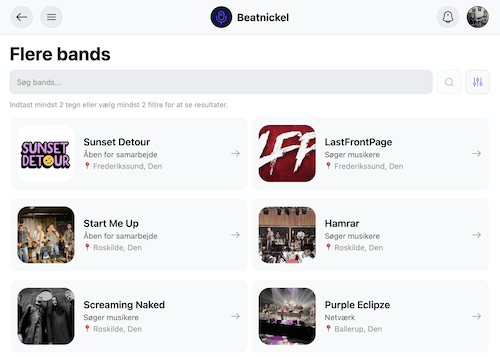
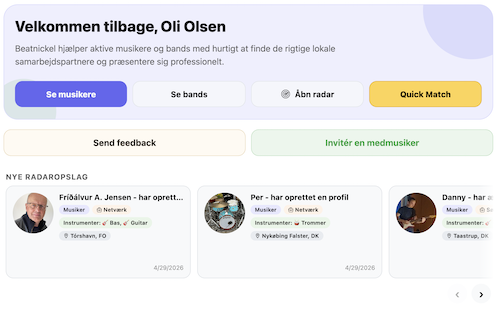
Instead of relying only on random posts, old networks or unclear messages, Beatnickel can give users better signals through profiles, status, search criteria and matches.
That makes it easier to see who fits with whom.
A drummer looking for a band nearby should be able to find relevant bands that actually need drums.
A band looking for a bassist should be able to find bassists who are actively looking for something new.
A musician who wants to start a new project should be able to find others with the same intention.
It sounds simple, but this is exactly what the music scene often lacks online.
Not everyone needs to be professional
Better signals do not mean that Beatnickel is only for professional musicians.
Quite the opposite.
Many amateur musicians are reliable, skilled and ambitious. They just do not necessarily need to call themselves professionals. They need a way to show what they want and what they are looking for.
The same applies to experienced hobby bands, young talents, songwriters and musicians returning to music after a break.
The music scene becomes stronger when more people can find each other on the right basis.
Less guesswork, more progress
When the signals are unclear, musicians are forced to guess.
They guess the level of ambition. They guess the seriousness. They guess whether a message is relevant. They guess whether it is worth meeting.
That is not efficient.
Better signals do not remove the need for chemistry, conversations and rehearsals. But they can make the first step much stronger.
They can help make sure that more meetings begin with a real chance of turning into something.
The music scene does not just need more posts, more groups and more profiles. It needs better signals.
When musicians and bands can clearly show what they are looking for, where they are and what they want, it becomes easier to find relevant collaborations.
Beatnickel can help make intentions visible, so users can understand each other faster and spend their time on connections that actually make sense.
In a music scene full of noise, clear signals are not just practical. They can be the difference between another loose contact and the beginning of something real.
Other blogs























































Discover a platform built to connect musicians, simplify bookings, and fuel creative growth.
Find us on social networks


